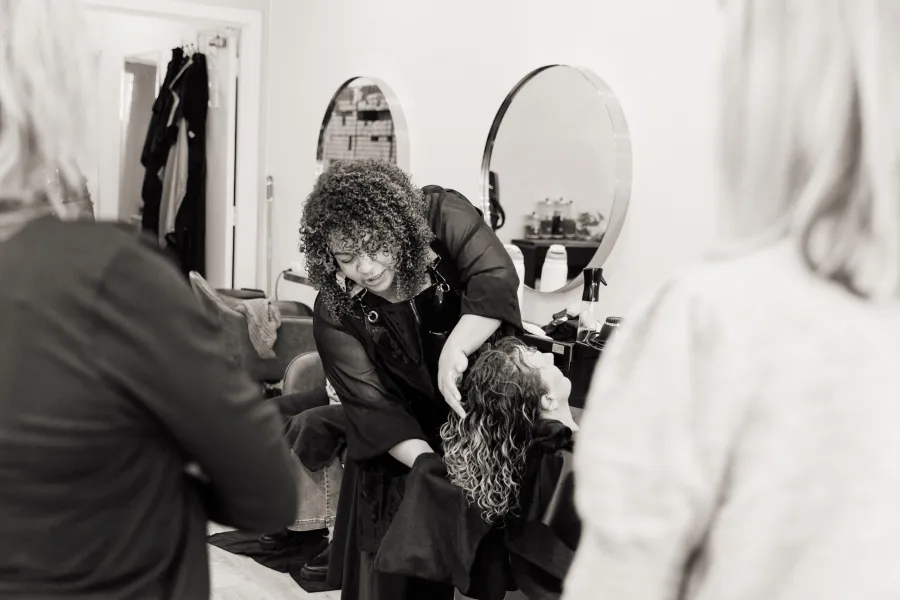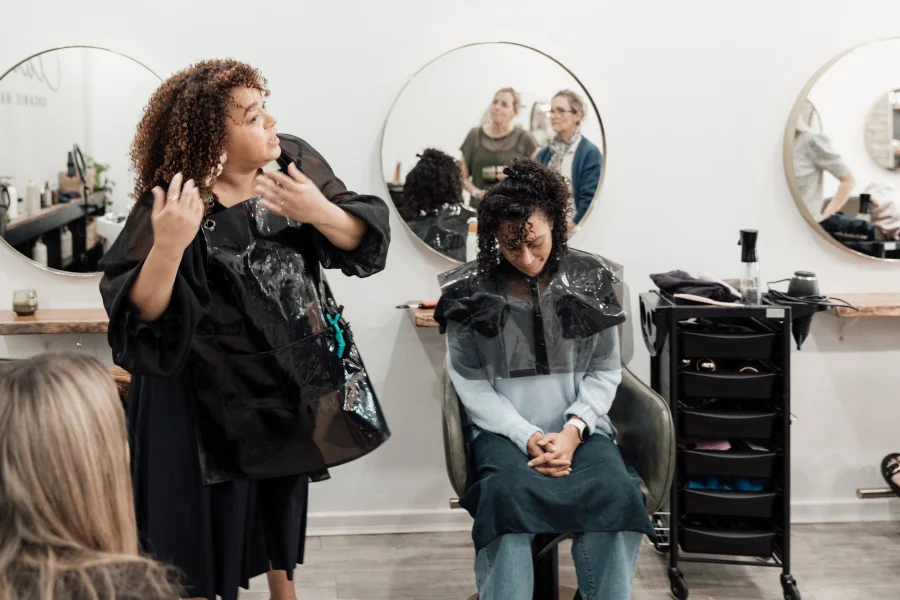
Curly hair education for stylists is more than learning how to cut curly hair. If you are learning how to work with curly hair, the starting point is reading the hair in front of you, and knowing why you are making the choices you make.
At Curl Identity in Mandurah, this is at the heart of how I approach education. Stylists need to look at the individual in front of them, understand their hair, and make choices that make sense for both.
And you don’t have to become a curl specialist to do that.
Why Curly Hair Education Matters for All Hairstylists
As a hairstylist, you already have techniques. You know how to create shape, remove or maintain weight, work with length, and style hair.
Learning to work with curls specifically does not mean forgetting everything you already know. What changes is the context in which you use those skills.
Curly hair can vary enormously from one person to another. Two clients can have curls that look similar at first glance but have very different density, texture, shrinkage, condition, and behaviour. They may also have completely different lifestyles and ideas about how they want to wear and care for their hair.
That is why learning another technique can only take you so far.
Good curl education should help you comb through all the noise, trends, and conflicting advice surrounding curly hair, and simplify it into something practical for what is, after all, a very common hair type. Pun intended.
Start With the Client, Not the Technique
For me, consultation is not only during the first part of the appointment, but the foundation for everything that follows.
Before deciding what you are going to do with the hair, understand the person attached to it.
What do they want from their appointment? What do they like about their curls? What frustrates them? How do they currently care for their hair? How much time do they realistically want to spend styling it?
These answers matter.
A client might show you an inspiration photo, but your job is not necessarily to reproduce that exact head of hair. Understanding what they like about the photo can help you work out what they actually want and how that idea could translate to their own curls.
Their lifestyle matters too.
A haircut or style can look beautiful when they leave the salon, but if maintaining it requires a routine they are never going to follow at home, it may not be the right result for that client.
A thoughtful consultation helps you understand both sides of the equation: the result your client wants and how they realistically want to live with their hair.
Learn to Read the Hair in Front of You
Once you understand the client, turn your attention to their hair.
This is where it can be tempting to identify a curl type and assume you know what comes next, but curl pattern is only one characteristic of the hair.
The more useful question is: What is this particular head of hair telling you?
Curl Pattern
Curl pattern describes the shape and formation of the curl, from waves through to curls and tighter coils.
It is useful information, but it is not an instruction manual.
Two people can have a similar curl pattern while having hair that behaves very differently. Pattern should therefore be considered alongside the other characteristics you can see and feel.
Hair Density
Density is about how much hair is present on the head.
It is easy to confuse density with texture, but they tell you different things. A client can have a lot of fine hair, for example, or fewer strands that are individually quite coarse.
Knowing whether you are working with lower or higher density gives you context for how the haircut you are planning may translate on that particular head of hair.
It is not about learning a “low-density haircut” and a “high-density haircut.” It is about understanding how density may influence the choices you make about shape, weight and the finished result.
Hair Texture
Texture refers to the thickness of the individual hair strands, which can generally be described as fine, medium or coarse.
Again, this is information rather than a formula.
Understanding the texture of the hair can help you think more carefully about how you handle it, the techniques you choose and the styling products you use.
Porosity and Hair Condition
How the hair interacts with water and products can also tell you something about what you are working with. Rather than treating porosity as another label that automatically determines what you should do, consider it alongside the condition and history of the hair.
Has the hair been coloured? Is there existing damage? How does it respond when wet? How does it behave when products are applied?
Each observation adds another piece to the picture.
Shrinkage
Curly hair can sit very differently depending on whether it is wet, stretched or allowed to fall naturally. Understanding that movement between stretched length and natural resting length is important when you are thinking about the shape and length you want to create.
The point of looking at all of these characteristics is not to categorise your client perfectly. It is to gather enough information to make better decisions.
How Should Hairstylists Approach Cutting Curly Hair?
When you first start researching how to cut curly hair, you will find plenty of techniques and plenty of opinions about which approach is best. Wet cutting. Dry cutting. Curl-by-curl cutting. Different methods of layering, shaping and creating or removing weight.
These are all tools.
The important question is what you are trying to achieve with the hair in front of you.
Before choosing an approach, consider everything you have already learned. What does the client want? How do they normally wear their hair? Where is the density? How much shrinkage are you seeing? Are there different patterns or behaviours across the head? What shape are you trying to create?
There does not have to be one universally correct way to approach every curly haircut. The more you understand the hair, the more context you have for deciding which of your techniques makes sense and why.
This is particularly important when considering whether to work with the hair wet, dry or through a combination of both. Rather than treating one method as the rule for curls, understand what each approach allows you to see and achieve.
Common Mistakes When You Start Working With Curls
So you found a cutting method that worked beautifully. Or a styling combination that gave one client great definition. Naturally, you want to repeat it. The problem comes when we assume the same choice will produce the same result on the next person.
Another common mistake is focusing so heavily on the finished salon result that we forget what happens when the client goes home. If they do not understand what you did, why you did it or how to work with their own hair afterwards, a beautiful finish only takes them so far.
Working with curls becomes much easier when you stop asking, “What do I always do with curly hair?” and start asking, “What do I need to understand about this client and this head of hair?”
Styling Is Another Opportunity to Understand the Hair
A product that gives one client the result they love may feel completely wrong with another. The amount of product, how wet the hair is during application, how the product is distributed and how the hair is dried can all affect the finished result.
Instead of looking for one product combination you can use on every curly-haired client, pay attention to what happens as you work. What does the hair need? What finish does the client want? How much styling are they realistically going to do themselves?
Again, this comes back to consultation. We ask our clients questions because the goal is to create something that makes sense for the person who has to recreate and live with it.
Educating Your Client Is Part of the Service
I believe your client’s understanding of their own hair should be just as important as the result you create for them.
You have the opportunity behind the chair to help someone make sense of hair they may have struggled with for years. That doesn’t mean overwhelming them with technical information or giving them a complicated routine to follow. Simply explain what you are noticing: tell them why you have made a particular choice; show them how much product you are using and how you are applying it; help them understand what they can realistically do when they are standing in their own bathroom.
When clients understand their hair, they are better equipped to care for it after they leave the salon.
How to Work With Curly Hair as a Hairstylist Without Becoming a Curl Specialist
Learning how to work with curly hair as a hairstylist does not mean you have to specialise in curls. Realistically, many stylists will work with all types of hair, and simply being equipped to welcome a curly-haired guest into their chair is a goal enough.
Curls may never become the main focus of your salon work, and that is completely fine. What matters is being able to welcome a curly-haired client into your chair and have a foundation to understand what you are seeing. That is what curly hair education for stylists should give you. It should help you ask better questions, recognise the characteristics that matter, and make choices you understand.
You already have skills as a hairstylist. Curl education just helps you understand how to use those skills more intentionally when the person sitting in front of you has curls.
The Curl Identity Approach
My approach to curl education has been shaped by personal hair struggles, and more than two decades in the hair industry. Growing up, there was so much emphasis on what made curly hair different. It was easy to feel overwhelmed and discouraged, as though curls required an entirely separate idea of hairdressing.
Over time, I realised that what I needed wasn’t more rules to follow, but to make sense of the information I already had. To understand the hair in front of me. To ask more useful questions during consultation. To consider how the person actually lives with their hair. And to make technical decisions based on all of that information rather than following a method simply because the client has curls.
That is what shaped my approach today: simplifying curl education and bringing it back to practical foundations.
Curly Hair Education for Hairstylists in Mandurah and Across Australia
Curl Identity in Mandurah is designed for hairstylists at different points in their journey with curls. You might simply want to feel more confident when a curly-haired guest books into your existing clientele. You might be beginning to explore curls more seriously. Or you might want to develop this into a specialist area of your career.
All three are welcome, because there is no single go-to approach for every curl guest, and no single point at which a stylist is ready to learn.
If any of that sounds like where you are, have a look at the education options at Curl Identity. Hands-on training, clear fundamentals, and language you can use with every guest who sits in your chair. No pressure to specialise.