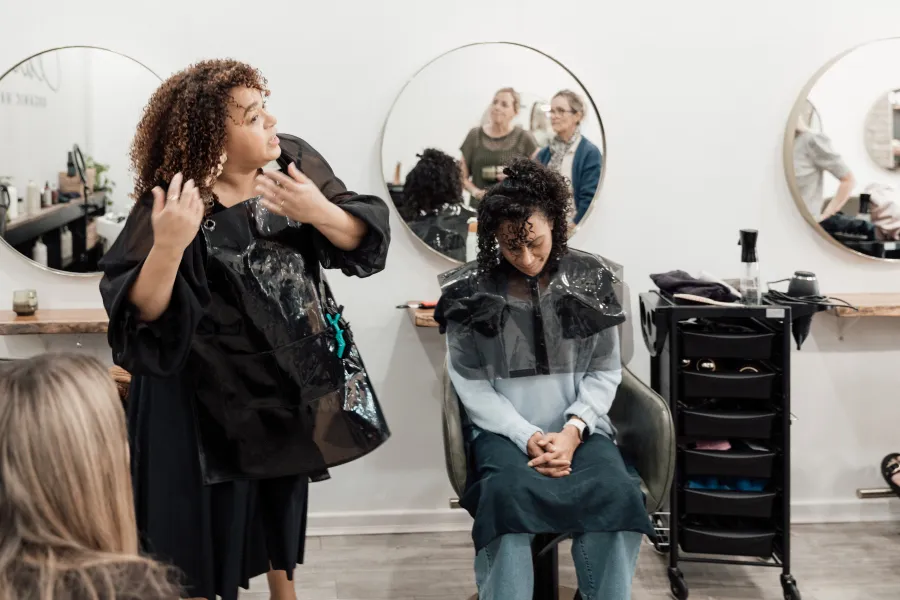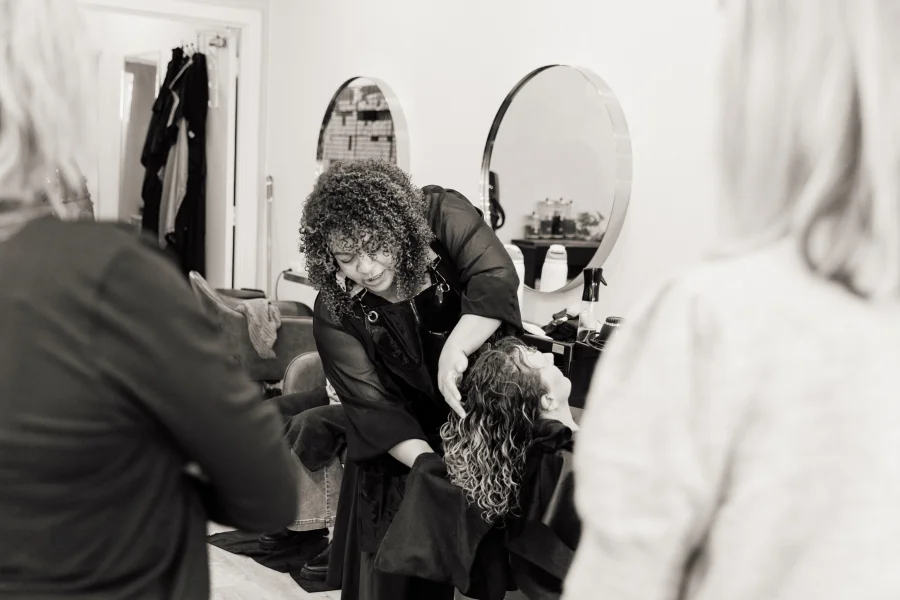
When you are working with curly hair as a hairstylist, it can be tempting to look for a technique or set of rules that tells you exactly what to do. But good curly hair education for stylists should help you understand that learning how to work with curly hair is less about finding the right formula and more about understanding the person and the hair in front of you.
There is so much information about curls available now. Between techniques, curl typing, product rules and constantly changing trends, it can be easy to feel like working with curly hair requires an entirely different rulebook.
But it doesn’t need to be that complicated.
Many of the mistakes I see stylists make when they are starting with curls come from trying to find certainty: the right way to cut, the right product combination or the right routine. Instead, I want you to start with what you already know as a hairstylist, then build your understanding of curls so you know how to apply those skills to the individual in your chair.
Mistake 1: Looking for a Go-To Curly Hair Technique
Learning new techniques is important. The mistake is expecting one of them to become your answer for every curly-haired client. A technique that worked beautifully on one head of curls may create a completely different result on the next.
Before deciding how you are going to cut the hair, ask yourself what you are trying to achieve.
Look at the shape the client wants, how their hair naturally sits, where they carry density, how much shrinkage you are seeing and how they normally wear their curls.
Once you have that information, you can choose from the techniques you already know rather than allowing the technique to make the decision for you.
Mistake 2: Relying Too Heavily on Curl Type
Curl typing can give you useful language to describe the shape or pattern you are seeing, but knowing someone has 2C, 3A or 4A curls does not tell you everything you need to know about their hair.
Two people with a similar curl pattern can have very different density, texture, condition, and shrinkage. They can also want completely different things from their hair.
Instead of trying to perfectly categorise the curls, look at the bigger picture. Curl pattern is one piece of information alongside all the other characteristics you can observe.
Mistake 3: Following Curl Trends Instead of the Hair
There will always be a new curly cutting technique, styling method, product combination or rule being talked about. Some of those ideas may be incredibly useful. Others may not be useful for the particular client sitting in your chair.
When working with curly hair, come back to what you actually know about that client and their hair.
What result are they looking for? How does their hair behave? What have you noticed about its density, texture and condition? What are you actually trying to achieve?
This is where curly hair education for stylists becomes useful. Rather than giving you another rule to follow, it should give you the understanding to decide which information, techniques and ideas are relevant to the person sitting in front of you.
Mistake 4: Forgetting About the Person Attached to the Curls
It is easy to become so focused on understanding the hair that you forget there is another important part of the Curl Profile: the person.
A good consultation should tell you more than what haircut your client wants. How do they normally wear their curls? How much time do they want to spend styling? What have they struggled with? What do they actually like about their hair? What does a manageable routine look like for them?
If someone wants a simple routine, creating a result that requires multiple products and a lengthy styling process may not make sense for them, even if it looks beautiful when they leave the salon.
Understanding curls changes everything.
Mistake 5: Focusing on the Result Without Explaining the Why
Your client can leave your chair with beautiful curls and still have no idea what to do with them tomorrow. This is why I believe educating your guest is part of working with curls.
You do not need to turn their appointment into a hair science lesson. Keep it relevant to their hair. Explain what you are noticing. Talk them through why you chose a particular approach. Show them how much product you are using or what you are doing differently during styling.
A beautiful result matters. Giving someone the understanding to work with that result at home matters too.
Mistake 6: Thinking You Need to Become a Curl Specialist
One of the biggest misconceptions around learning how to work with curly hair as a hairstylist is that you need to completely retrain or become a curl specialist before you can confidently welcome curly-haired clients into your chair.
You don’t.
You already have skills behind the chair. Curl education gives you another layer of understanding that helps you decide how to use those skills with different heads of hair.
Start with the client. Understand the hair. Know what you are trying to achieve. Then choose the technique that makes sense.
Start With Understanding
You are not trying to memorise the answer for every curly-haired client who walks through your door. You are learning how to gather the right information so you can make an informed decision for the individual sitting in front of you.
That is a much more useful foundation than any single curly hair rule.
Curl Identity provides practical curl education for hairstylists from Mandurah, Western Australia, helping stylists build their understanding of curls without the pressure to specialise.